ARTIST STATEMENT
The Heart
This body of work is an inquiry into one question: Where does Africa’s positive future live?
My answer is consistent across every canvas: It lives in the heart of its women.
This collection is not about women as a subject. It is about women as the foundation. The builders. The architects who were never credited as such.
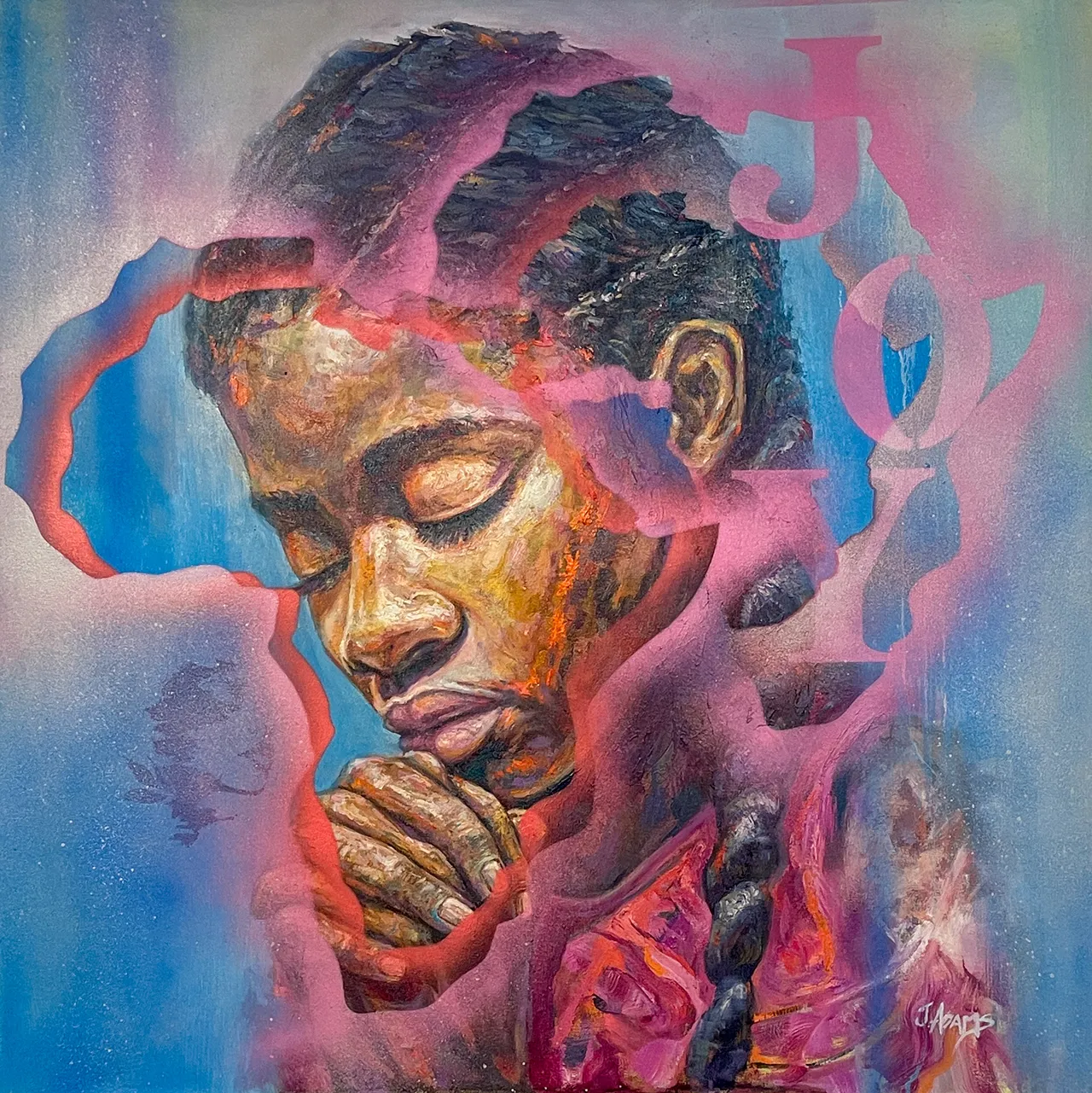
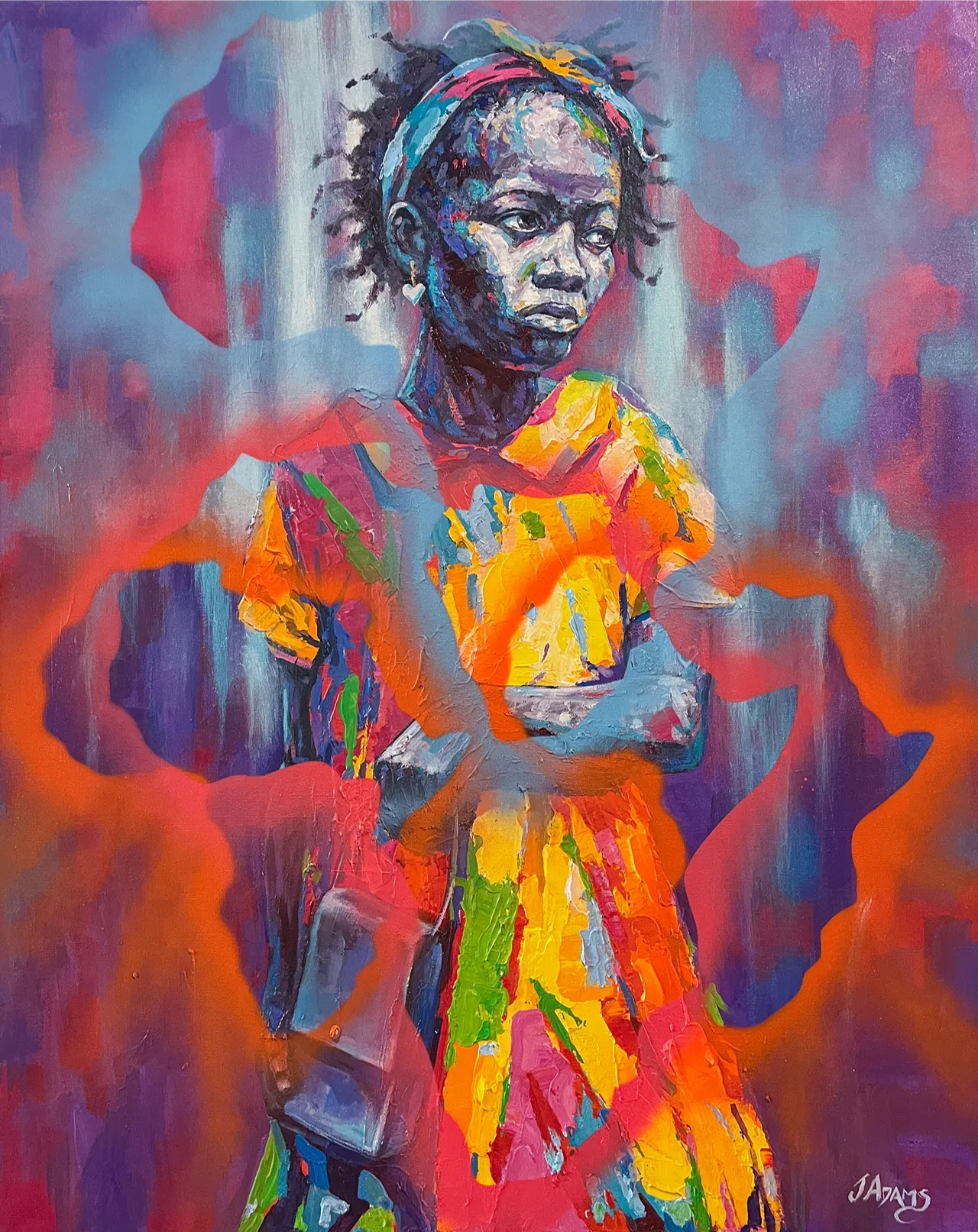
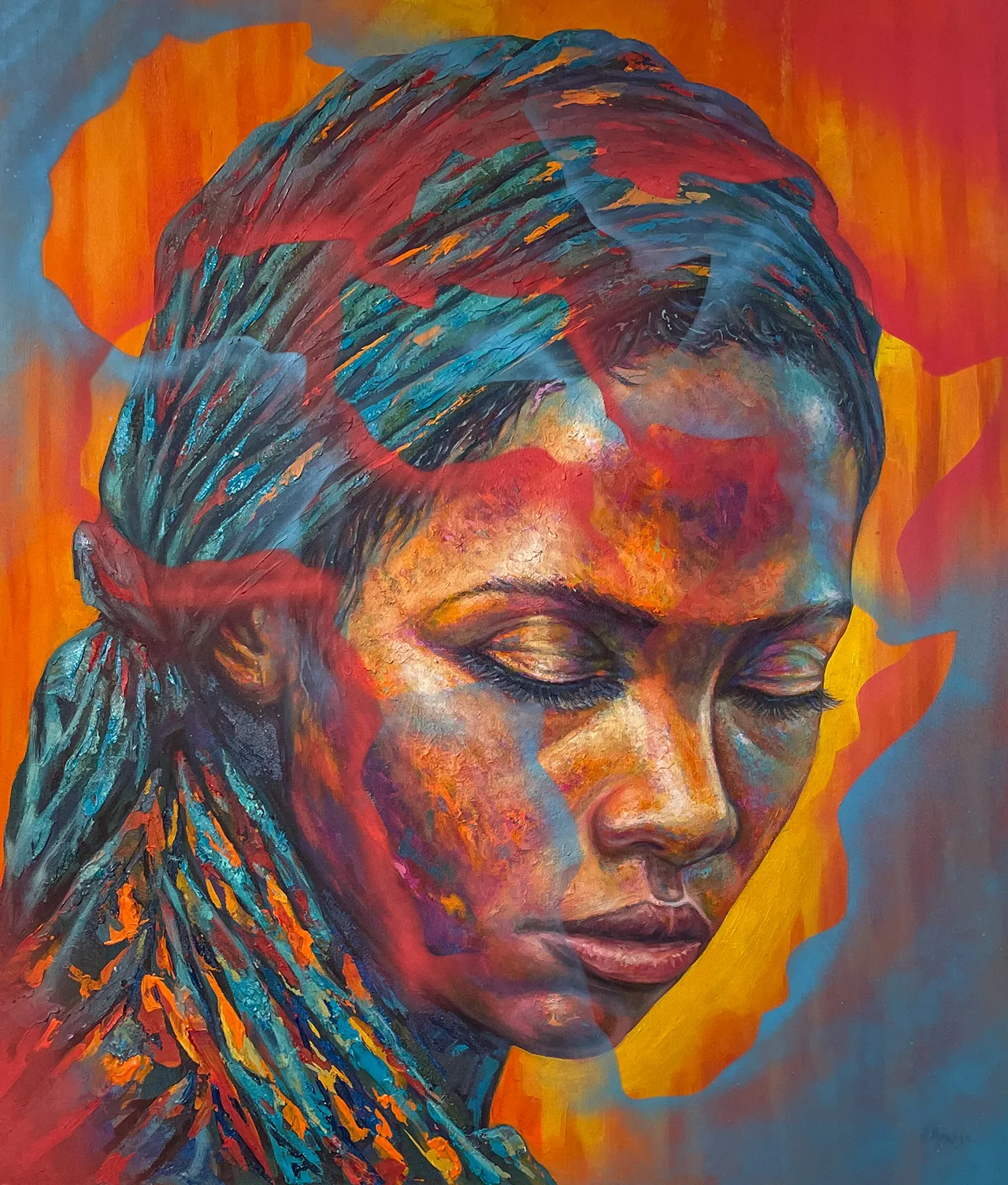
I paint the women who have actually built this continent with their bare hands. The gogo who, long after she should be resting, is raising her grandchildren as her own. The single mother who performs the daily miracle of keeping a household together with little and making it look like more than enough. The intercessors, the prayer warriors, whose quiet prayers in kitchens and on taxis and in early morning darkness have been the unseen infrastructure holding our communities together.
Each portrait in this series places her within Africa, and Africa within her. The map is not just a symbol—it is a veil, a scar, a mantle. She carries the continent because the continent has been carried by her.
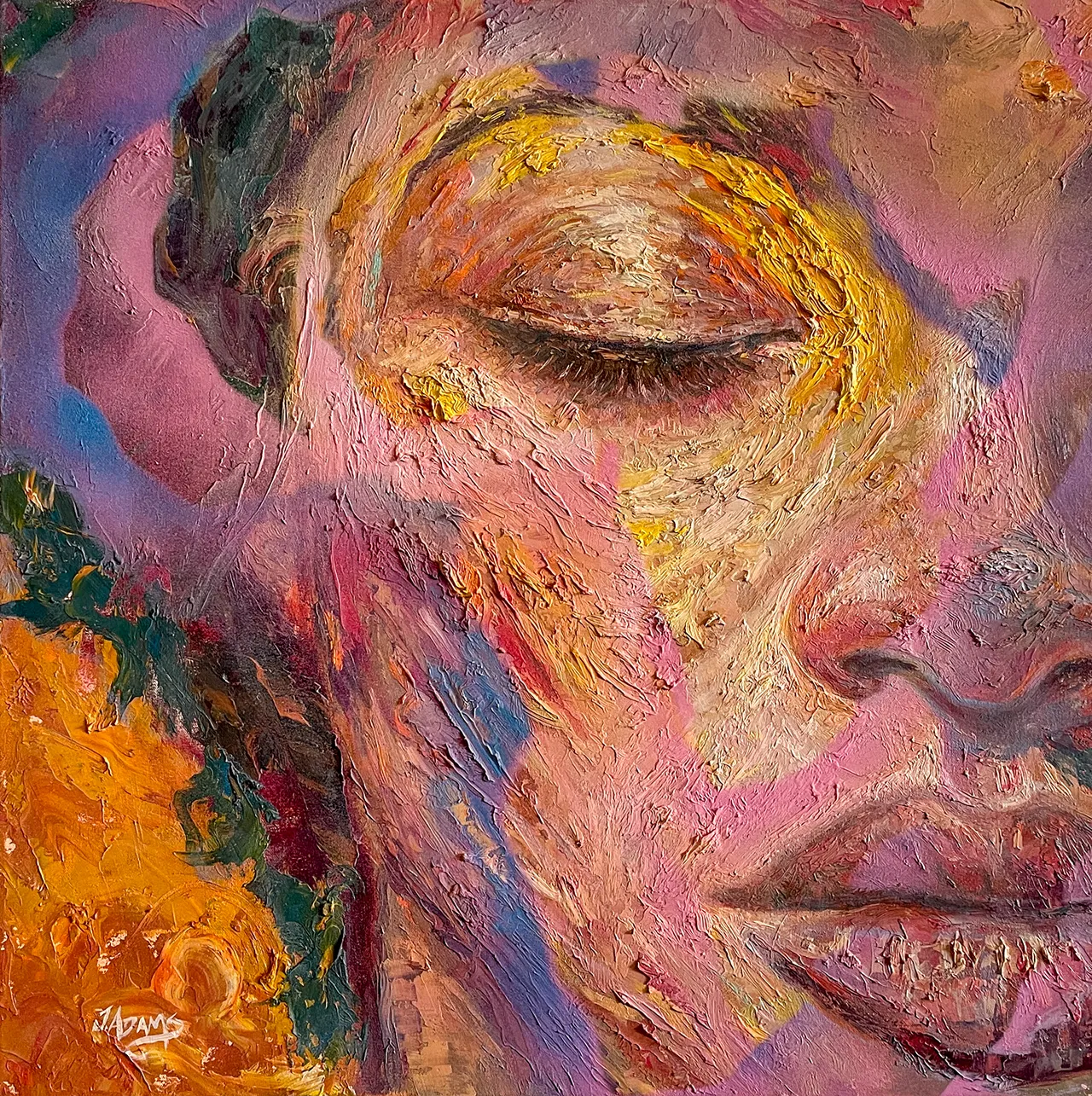
My process mirrors her story. Underneath is a classical, reverent, oil-painted portrait—dignified, timeless, sacred. Over it, I layer interruption: spray paint, stencils, graffiti, raw texture. Words like JOY, HOPE, STILL. These layers represent the noise, the abuse on many levels—physical, systemic, verbal—and the marginalisation within a masculine society that has tried to overwrite her, define her, degrade her.
But in every piece, she is not erased. She emerges through the degradation. The oil still glows beneath the spray. The prayer still holds. The gaze, even when her eyes are closed, remains unbroken.
She did not just survive the breaking—she forged a way through it.
This collection is my act of witness and my act of honour. It is to say: If Africa has a future worth believing in, it is because her women never stopped believing in it for us.
ARTIST BIOGRAPHY
John Adams is a painter at his core but a cutting-edge creative by heart. The process of painting, and not just the depiction of form, is part and parcel of his creative art.
From observing and watching artists like Pollock and other action painters, John has been inspired to create the paintings that he does so effortlessly. The “ground” construction is just as important as the portraits which are interlaced. The effervescence of the painting gestures serves to better establish the combination of the portrait as a unit. One without the other is non-existent.
Adams’s central focal point is portraiture. While some subjects are chosen by emotion and depicted through expression, others are more personal to his life’s journey.
The scale of his work varies according to the composition of the image and its message. Oftentimes, odd shapes like ovals and round canvases are options for a softer focal point, mimicking looking through the eye, as we see in an orb naturally. Narratives, conjured up through the depiction of feelings through eyes, lip tension, moisture in the eyes, and direction of a gaze, spur this on.
The portrait is allowed to breathe in and absorb the ground (foundational painting). Often, there are interruptions of texture, flat strokes, or sprays of colour which weave through the surface features.
A subcutaneous world is established through layers and different hues of colour supportive of the image. A paint run now becomes a tear; a splash now embodies a heartbeat; a glue blob now becomes a tempestuous moment in life.
The landscape of the surface finds its bearing by the heartbeat of the patterns and strokes of definition and mediums. Charcoal’s dark hues serve to form the dark colour of faces where paint is expected. This draws the viewer towards the canvas and serves as visual interest simultaneously, among other techniques used.
Spliced sections of the canvas are unused or uncovered by sanding through layers of paint or masking. A somewhat mechanical stroke composition of squares opens up to window layers defining the shapes. This is in rhythm with the tools used in painting the ground and those used by Adams in his other crafts. Large scrapers, carving knives, filling knives, ink rollers, and metal plates all form part of his infantry.
Unlike the vast expanse of Pollock’s drips, Adams holds onto the solitude of expressive figuration as his focus. Therefore, the viewer is returned to the harmony of the surface and subject of the painting.
Adams speaks about “A flurry of blows... The equal but opposite reaction of painting... Intentional accidental paint application...” almost as if he is in a fight or a scientific experiment of matter and materials.
Mixtures of mediums have left residues from roof to corners, both on his studio and clothes. Just like they have on his life and view of things to come. As the paint is pliable to the hand of the artist, so Adams feels teachability is a necessary arrow in his quiver. He intrinsically believes that the action of application of painting must still remain in the residue on the canvas, or its life has gone.
He ascribes portraiture as the keyhole to the “larger picture” of this universe, his universe, and a simple entrance into his universe. Although he has not defined it completely, it does give the audience at large an insight into the portrait, serving to funnel attention to the monumental landscape of the human journey.
A genre most dear to him is the complexity of nature and the viscosity of its parts. The intertwining and translucency which interplay so effortlessly were spurred on by his plein air oil painting trips overseas. This is part of his present repertoire, hinging on classical studies of both present masters and those of the classics, like Monet and Bierstadt.
Courage is not found in the armour we wear, but in the spirit that refuses to break. This body of work speaks to the quiet suffering we carry within us—the pain that is often hidden beneath the surface, held in the body, remembered in silence, and transformed over time. It explores the moments when we feel fragile, wounded, or undone, and yet still find the strength to continue.
Suffering can leave marks that are not always visible, but those marks become part of our story. They shape us, test us, and reveal what we are made of. Through this work, pain is not presented as weakness, but as evidence of survival. Each struggle becomes a layer, each scar a record of endurance, and each moment of darkness a place from which new strength can emerge.
I am interested in the tension between vulnerability and power: how the human spirit bends but does not disappear; how we can feel broken and still remain whole in ways we do not yet understand. The works reflect the process of facing pain, carrying it, and slowly reclaiming oneself from it. They honour the strength it takes to keep moving, to heal, and to rise again, even when the weight of experience feels overwhelming.
Ultimately, this statement is about resilience: the ability to transform suffering into meaning, pain into wisdom, and survival into beauty. It is a reminder that strength is not always loud or visible. Sometimes it exists in the simple act of continuing, in the decision to hope again, and in the courage to rebuild from what once tried to destroy us.
